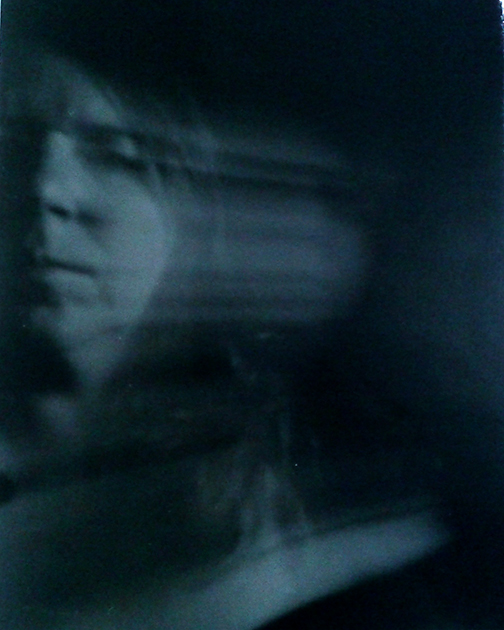
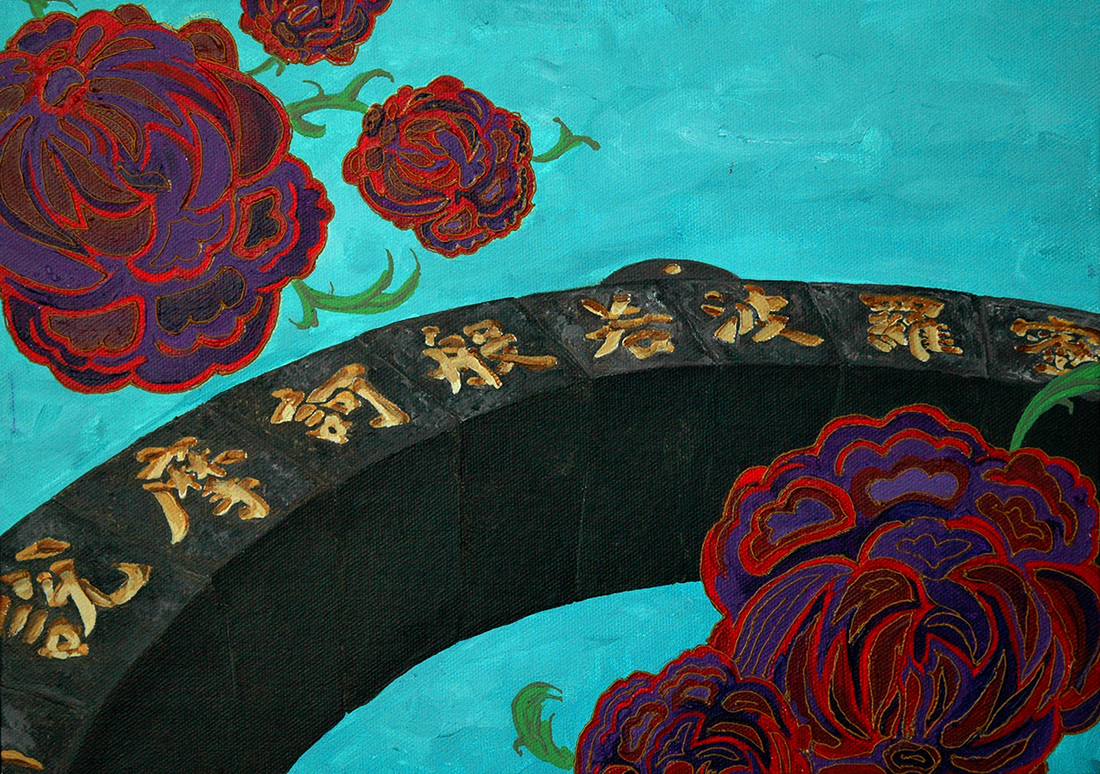
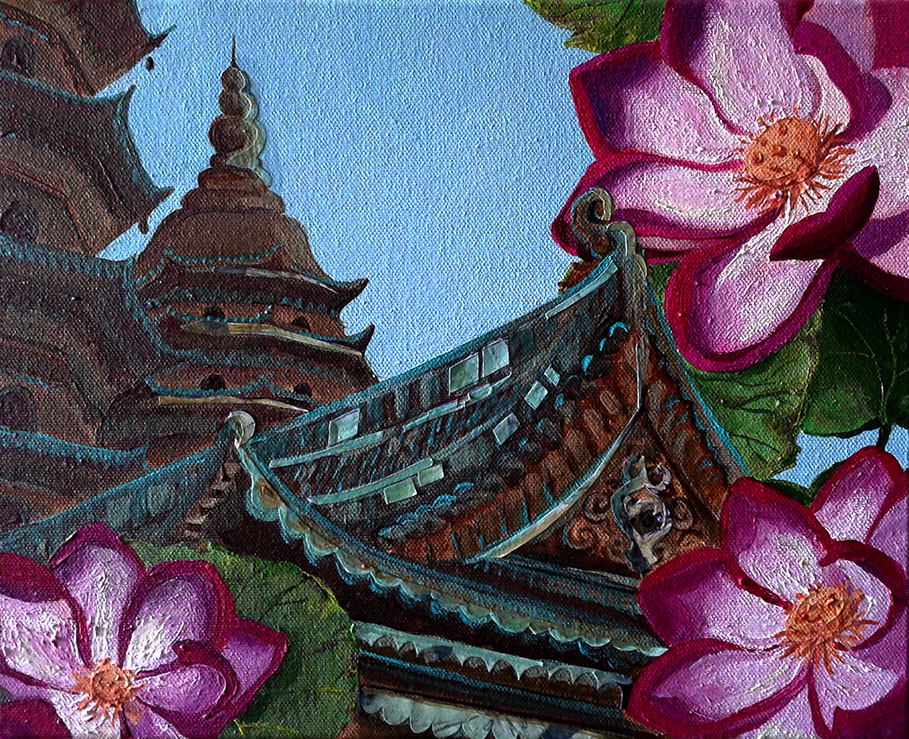
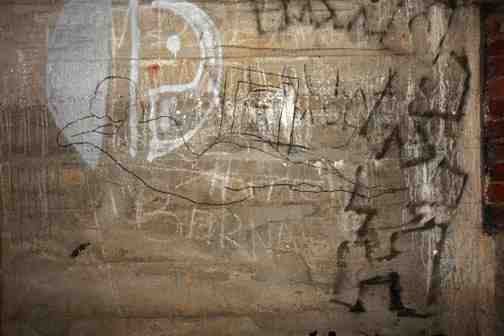
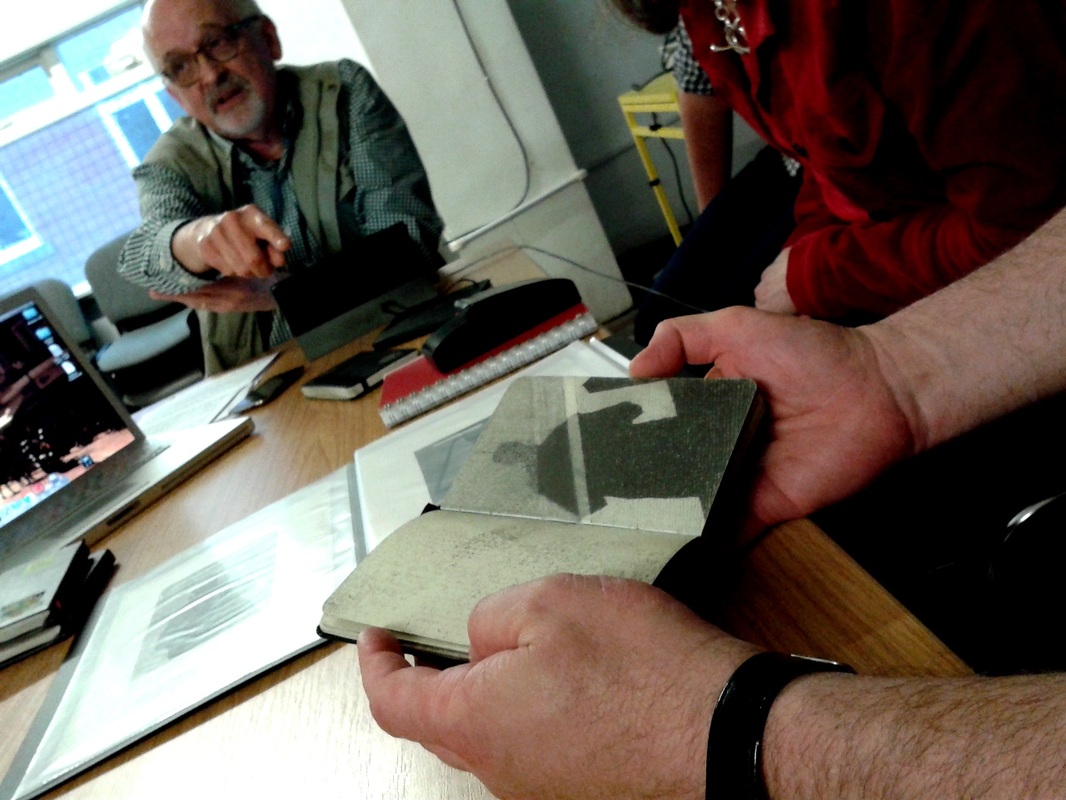
An exciting May meeting saw us sharing our final responses to the Creative Whispers project and it was fascinating to see the number of ‘threads’ that felt as though they had come, at least to some degree, to a conclusion in a full circle. There was some discussion that it had been challenging not to be influenced by the breadth of responses as well as the piece that was supposed to be the focus and many questioned the role of the subconscious in this. Being made aware of something, whether that be a material or conceptual approach may influence a practitioner unintentionally but are we always really aware of what we are aware of? Can we avoid our work being influenced by these things, whether that be through an attraction or an aversion to them and what does this imply for our work? Aside from an exploration of our relationships with spaces (domestic, urban and rural) which really did seem to underpin a vast majority of the work, one key question that seemed to come up in relation specifically to the collaborative element was that contrast between destruction and preservation; is it acceptable to destroy in order to develop or should we aim to preserve wherever possible?
I shall skip over these issues in written form as briefly as we did at the meeting; we swiftly moved on to the nuts and bolts of planning the CRITshow on Saturday and it is at this event that we intend to really dig deep into the questions that have arisen from the project. On Saturday morning (you can join us from 10am); we will be sorting and displaying all the outcomes in one more or less logical form or another! Some talk has involved use of physical threads to illustrate the paths of response, while the likely display has also been described as something of a Venn diagram! We will then spend the afternoon in small groups responding further to the outcomes and indeed the entire project in a practical fashion, so there will even be a further series of collaborative outcomes! We will conclude with a discussion of both the project and the day and a bit more analysis of some of the previously mentioned observations along with anything else that crops up!
A very exciting development for CRITgroup and as far as I am concerned, the 25th of May can really not come soon enough!
Next month we will meet on Wednesday June 26th and there will probably be a ‘reflective debriefing’ on the May event in terms of what we have learned from the organisation of it but also how we want to move forward into phase 2 of our collaborative research project. If you are interested in getting involved, I highly recommend coming along to that meeting, even if you can’t make it on Saturday the 25th!
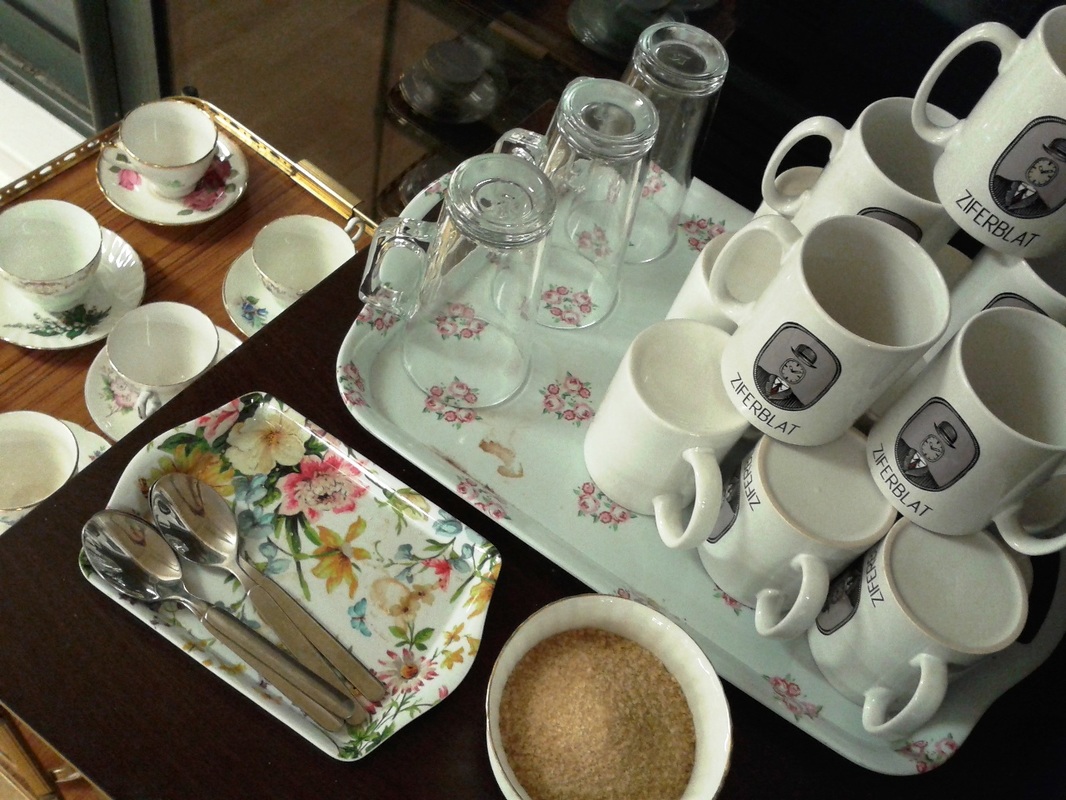
It was a short yet sweet meeting this month; there were four of us present, though we had a full contingent of Creative Whispers responses as those who couldn’t make it had either emailed or posted their work in. For once, deciding who would get which response next was easy as it was our final swap and so it was simply a case of passing on pieces to someone who had not yet worked on a particular thread. We briefly reviewed and discussed the contributions (as well as engaging in some particularly interesting conversations surrounding ownership of artwork) before moving swiftly on to the exciting business of discussing our upcoming CRITshow on May 25th! Initially proposed as a group Show event, as we have worked through the Creative Whispers responses (always intended to be a research project) it has become clear that what we are working towards is not so much a polished or traditional exhibition of art work but instead a continuing of the investigative nature of the whole process. We have decided that the hanging of the work is a critical part of responding to each other and our perceptions of discipline and so we will embrace this and make it a part of the event. We will give ourselves three hours at the start of the day in a collaborative hanging and curation session which will culminate in the work being… somehow… displayed! We decided an effective way of illustrating the potentially confusing ‘threads’ of responses was by utilising just that; a series of threads, which we plan to use to indicate connections between the pieces, from one to the next, or maybe several flowing into one. We anticipate the outcome to resemble a giant art-based cat’s cradle, or maybe a rather creative spider’s web! Of course this is a somewhat movable feast owing to the flexible nature of the project but quite an exciting prospect none the less and I for one am really looking forward to putting the work up now (which I often find one of the least enjoyable parts of exhibiting!). The rest of the CRITshow day will be spent in further collaborative responses, where we plan to work in small groups to either suggest a potential development or even produce further pieces. We will then end with a group discussion on the day, work and project whilst enjoying some well-earned afternoon tea (thanks to Christine for agreeing to organise this!). We have yet to pin down exact times for the day but I hope to have those details soon and we will then publish our official invite!
We have just one more meeting before the CRITshow, next month on Wednesday 22nd of May, at which we will share our final responses as part of the Creative Whispers project. We’ll also have some last minute discussions on the content and format or the CRITshow! Can’t wait!
There were lots of things to get through this month so we started off by looking through some copies of Patternotion; the book published as part of a project by Alban Low which looked at different systems for facilitating creativity. As we felt that the current Creative Whispers project fitted this theme pretty neatly, we submitted some work at the start of the year. Everyone agreed that our contribution worked well in the book and we look forward to involving it somehow in the CRITshow event on the 25th of May. Our main ‘feature’ this month was a talk by Christine Wilcox-Baker, who has been a regular attendee at CRITsessions since early on. Christine has some upcoming talks to give at various events and was eager to not only share her work with us but also get some feedback on the content and pace of her presentation.  Rainbow Chard I have shared details of Christine’s work before, especially last August, following her involvement in a show garden for the RHS Flower Show at Tatton Park. Her practice is largely inspired by plants, especially those that provide us with food and she is interested in exploring issues of man’s interaction with, reliance on and increasing disconnection from the natural world and the sources of our sustenance. Her practical outcomes cover a broad range of different disciplines and the work she shared included installations, paintings, illustrations, metal work, exterior 3D design, textile design and environmental interventions involving plant growth. It is perhaps no surprise to learn that her equally broad industrial background includes graphic and interior design as well as work for TV. Following her involvement in Cow Parade, Manchester in 2004 however, she discovered a love for public art and it was following this personal creative revelation that she embarked upon (almost!) a decade of work committed to the natural world, including the completion of an MA in Art as Environment.  Potato Couch One of the key things that came from Christine’s talk (aside from a shared appreciation of her accomplished and varied work) was again the question of how one describes a practice and whether or not it should be considered a strength or weakness in an artist to be simultaneously engaging in a range of disciplines. One question posed to us at the start of the talk seemed to almost ask for help defining the body of work presented but it was a unanimous response that the work defined itself and that in this case it was the concept that was the key uniting element rather than the method of expressing it. As Christine had already mentioned that she was viewing the talk as a ‘dry run’ for various professional commitments, the conversation naturally led on to issues surrounding how best to approach applications for a variety of opportunities and whether or not things should be left out of a portfolio presentation if they did not obviously ‘fit in’ with what might be perceived as a main body of work. It was agreed that much like in any industry, it would be appropriate to ‘tweak’ or review this with relevance to each application and that sometimes it would indeed be better to present a more focused series of work but that this fact did not undermine the validity of engaging in a variety of disciplines as part of a justifiably consolidated practice. Christine’s talk was an inspiring demonstration of how one opportunity can grow into another in a very organic fashion and there seemed to be much about her approach that mirrored her subject matter; by ending on an outline of her upcoming projects it was certainly clear that this fertile practice is not only blossoming but definitely bearing fruit! Though we missed Shirley and David this month, they had still managed to get their Creative Whispers contributions in to us and so reluctantly moving on, we spent the next half hour sharing the third round of responses. These can be found on the Response 3 page. We have one more swap, at next month’s meeting, before concluding the project with the CRITshow event. We also spent some time discussing how we are going to approach this and it was agreed that the day will take the form of further research into our original question, rather than attempting to realise a ‘polished’ show. The focus of the work displayed will very definitely be on the process of the Creative Whispers project and will hopefully enable us to effectively reflect on the findings of this an equally dynamic and creative fashion. As mentioned, next month is our final swap and we will also spend a bit more time working out how we will tackle displaying the work. We all felt that making the concept explicit was critical and there are a variety of ways that we could approach this so it will require some further discussion. On another note, I hope to be confirming new dates for the rest of 2013 soon and I shall publish these on the home page as soon as I have them!
 Christine reveals her illustrative responses Tonight we started off with a bit of housekeeping and discussed the outcomes of a meeting I had with one of the directors of MadLab about potentially arranging an exhibition of the Creative Whispers work. As expected, cost is going to be the main factor in deciding how long for and when we want to do anything but aside from sending me back with a new list of questions it seems we are still looking likely for getting something organised in the near future. Once we have agreed dates (and how we will pay for it!) then we can start discussing the finer details of organisation. We were also pleased to welcome back Jo Scorah who shared her textiles work with us last October. We were of course keen to get on to sharing the second round of responses for the Creative Whispers project and started with James Sharp, volunteered to go first in his absence! James had taken my photographic responses to Irena’s starting point and had interspersed prints of the images with prints of his journal pages in to a bound, textile covered book.  David shares his interventions in Irena's found book We also looked at photograms from Irena, rubbings from Kevin, manipulated photographs from Shirley, Japanese additions to a found haiku book-come-photo album from David, Illustrations on canvas from Christine, a developed conceptual ‘object’ from Renate and finally a mixed media drawing from myself. Jo took away some prints that Shirley had made in response to Renate’s original acrylic on canvas starting point and will join in with the project in a ‘branched’ thread! This is really just an overview and you will be able to see more of these over the coming weeks as I get sent images with which to update the Creative Whispers project pages. We finished the discussion on the project with many agreeing that they have found the opportunity to take some risks and be a bit experimental very refreshing. While we may not all have produced work that we are necessarily happy with in a way that we would normally associate with producing work, we have certainly appreciated the stretch of being kicked from our respective ‘comfort zones’!  Glass and Ceramic Transfer by David Hammond As we managed to finish with a bit of time spare, we were delighted to hear more from David Hammond, a mature student now in his third year of a BA(Hons) in 3D Design at MMU, who shared some of his recent work with us. We discussed some photos of his work in glass; sculptural pieces that make use of ceramic transfer techniques to involve 2D drawings, photographs and collages of modern urban architecture in a spatial exploration. We discussed the link between the materials and the subject matter being closely related to David’s inspirations; the interaction between the buildings and the environmental features around them such as reflections and negative spaces. The glass, it was agreed, is a medium that naturally lends itself to play with light as well as reflecting (no pun intended!) the actual building materials of the architecture.
We are now looking forward to March, when we will be sharing the second ‘layer’ of responses as it gets increasingly complicated to pass on a piece without it going back to someone who has already worked on it! In addition, Christine Wilcox-Baker will be giving a much anticipated talk on her sculptural work relating to food plants and gardens! This seems particularly appropriate as we move into Spring; there’s certainly a lot of new creative growth sprouting about us; check back next month to see if it’s started blossoming!
This evening’s session was the much anticipated sharing of responses for stage one of our first collaborative project; Creative Whispers. We were also delighted to welcome two new faces, who briefly introduced themselves as Vikki Cutts (teacher, freelance art director, and playful crafter) and Amy Leak (recently graduated graphic designer, especially interested in developing brands using opportunities for digital interaction). We were also pleased to welcome back Irena and Renate who joined us for the first time in December; we obviously didn’t scare them off with our CRITmas antics!  James decides how to share Stage 1 responses We were keen to get on to sharing our work on the initial Creative Whispers starting points so we quickly moved on to circulating the results whilst the responding artist gave an overview of their approach. Photographs of these responses will soon be shared on a new page which will begin charting the evolution of the project but in the meantime, an overview can be found below.
This 'flow chart' will also form part of our group submission to a new book compiled by Alban Low titled Patternotion. Alban runs a variety of projects which he opens up to a growing fleet of artists, designers, illustrators and general creatives. This current venture looks to draw on approaches that such people format to achieve goals. He says ‘Our minds visualise the improvements and adventures of the future. To achieve these we must put a new system in place to achieve what we want.’ As Creative Whispers seemed a very clear example of a ‘self imposed schedule and idiosyncratic method’ of achieving an outcome, we have a few pages kindly reserved for us. If you’ve read this post you can consider yourself lucky enough to have glimpsed a sneak preview! So what is our outcome? Well, we have now agreed that Creative Whispers will have a ‘shelf life’ of up until a final swap in April. We will then continue talks with MadLab about arranging an exhibition of the work sometime after May.
Next Month we are looking forward to sharing the second response from the group project but as ever, we will also aim to make room for anyone who wishes to bounce any ideas or request any feedback. Until then… the old art-cogs are turning and I’d better get on with Whispering Creatively!
 A Festive Spread It wasn’t just the Christmas spirit that gave us cause to celebrate this evening as we marked CRITgroup’s first birthday with a (gentle mid-week) knees-up. We also got the ball rolling on our plans for collaboration through 2013 and welcomed along a couple of new faces to the crowd. We began the evening with social chat and nibbling; amongst other offerings, I subjected the group to home-made parsnip not-very-crisps and a choice of chilli or sage and onion houmous! A re-visitation of the more seasonally shaped ginger biscuits I first provided at Hallowe’en were then only slightly overshadowed by the selection of mince pies; ginger, cranberry or chocolate nonetheless!
 Sharing the Collaborative Project Starting Points and Waiting for James to Call! However, it wasn’t an entirely food themed evening (although the spread did seem to go down rather well!) and so we did eventually move on to business and got our first collaboration ‘Creative Whispers’ off to a festive start (You can read more about our project here). The contributions were pooled and shared out by our very own ‘Santa Crafts’, James Sharp, and we then opened the gifts to see what we had been challenged with. There were a range of offerings from drawn and painted starting points to the more conceptual. One of the first things we have agreed to do is document the initial item photographically and it is hoped that with each individual producing this separately, even these will contain idiosyncrasies which will give us an opportunity to reflect on the nature of creative practice. Next month we will pass on our responses and over the coming weeks I shall upload the documented starting points. Just after 8pm GMT we took a call via Skype from James Pashley, one of our original members who moved to Japan in the summer to teach English. James selflessly got up at 04.30 to be able to join us at the meeting and told us all about his experiences helping out on an orange plantation, partying with his colleagues, developing creative methods of introducing practical tasks to the English Language classroom and the slightly disturbing lack of cheese.
We wrapped up with a quick whip round the group to briefly introduce our respective practices for those only just joining us (this should probably have been done at the beginning but we were too busy with far more important things like crudités). This month we welcomed photographer Irena Siwiak Atamewan who has a particular interest in domestic spaces and abstract painter Renate Wendel who, coming from a background as a classical musician, is especially inspired by sound. I then gave an overview of the collaborative project plan for those who weren’t part of the original discussion.
Before we knew it, time had flown and all that remained was to share our last seasonal greetings and bid each other farewell until 2013… and I shall now do the same!
The first meeting of next year will take place on January 23rd and all details can be found on the main home page. Hope to see you there!
It was a small group of focussed, hard-core attendees this month to balance October’s packed out numbers! James Sharp, Kevin Linnane and I started off by looking through and discussing the use of Weebly as a tool for creating websites (including the one you are currently reading!) James has recently re built his own website having previously used a web designer and is finding Weebly a useful tool to give him control over the content, despite some frustration that there is not an option to automatically send an email out to a mailing list when he updates his blog. We discussed various elements within the tool including adding custom html (we didn’t manage to get that to work last night but I’m blaming the group downstairs for streaming video and slowing up the web connection!?) and using the revenue options for making sales through your site. This includes the welcome recent addition by Weebly (a US based company) of different currency options and not just USD! We also briefly discussed the pros and cons of social networking media as tools for promoting a practice as well as ways to link your different web presences (e.g. sharing website updates on Twitter, etc.) For the second half of the session, we got started on discussing a collaborative project for CRITgroup members, which is something that has been theoretically on the cards since we started. We agreed that there were two ways to approach this; a group show that simply allows us to showcase our individual practices but from the perspective of the CRITgroup or a more integrated ‘research’ project which would allow us to interact a lot more and would determine the direction of the outcomes. We agreed these would in fact both be interesting to pursue and so it was left for me to try and arrange time and space to show work (hopefully at MadLab) before following the group show idea up any further. We then spent the rest of the evening discussing how to best format a specifically collaborative project. Taking the CRITgroup concept as a starting point, we talked about the potential for basing our investigations around the perceived differences between ‘art’ and ‘craft’, as this has been a feature of our conversations in several meetings. This led us on to reflect upon the apparent need to ‘label’ oneself as a particular kind of practitioner (e.g. a ‘photographer’, a ‘painter’, a ‘craft worker’, etc.) and how those descriptions of discipline relate to our methods of approach for producing outcomes (if indeed they do). We eventually formatted three ‘mini projects’ which we now plan to run in order to first pin down and agree a clear research question that can then be used to inform the next working stages of the project. The idea of these is that by introducing particular boundaries or criteria, it will help us flush out key aspects of our respective practices which will better equip us to discuss our area of interest. For brevity, I am not including an outline of these in the text of the blog, however, if you are interested, you can download them. We will be kicking off the first one (which I have since titled ‘Creative Whispers’) at the next meeting which is also the CRITmas Party. If you are interested in collaborating, and I think that first and foremost this is going to be a lot of fun, please download the CRITmas Party invite for further details of getting involved! So, we approach the end of the first year of CRITgroup and it is with a warm sense of satisfaction that I look forward to celebrating this next month along with more than a hint of excitement for the future of CRITgroup into 2013, especially now with a view to our collaborative proposals! Don’t forget to have a look at the CRITmas Party and Invitation to Collaborate documents! This is the perfect opportunity to get involved if you’ve been monitoring us from afar but ‘never quite got round’ to popping along. Equally, if your practice in in need of a kick start, revamp or change of direction in the new year, what better way to get the creative cogs turning than a dabble in a group project? We hope to see many of you next month!
October‘s CRITgroup welcomed the long-anticipated Jo Scorah to present her work. Yet another multi-functioning creative practitioner, Jo was originally a dress designer before completing a degree in embroidery in 2004 and then moving on to an MA in textiles in 2008. She also runs a graphic design company but it was her sculptural textiles that she shared with us this evening. With a practice in this area that historically revolves around the body, this evolved during her explorations on the MA into far more sculptural pieces. | She employs an interest in mark making through stitch (amongst other methods) to bring textural detail into a series of works which investigate themes of transience in terms of homelessness or the need for refuge, particularly citing this in the context of military conflict. She draws upon her Libyan family background to inform this and also shared with us photographs taken of army encampments in Israel during the Lebanese war. Her sculptures realise aspects of this by referencing physical methods of carrying and housing personal belongings during such crises; soldiers bags, tents and temporary accommodation.
Much of her works exist both in and beyond the dual camps of garment and sculpture and she prefers to describe her practice as ‘sculptural clothing in an ambiguous way; 3D works of art that could be used in performance.’ Many pieces are both displayed in a gallery and worn in videos or photographs and her use of materials as well as the inclusion of the model invite the audience to consider the relationship between the external surface textures and the ‘refuge’ of the interior. She then uses features such as boning to create structure in the garments forcing the body into awkward positions which then cause us to question just how comforting the promised refuge can really be.
This dialogue between the internal and external is also used as a metaphor for conflict itself, as in ‘Bubble’, her MA show piece which references the Middle East conflict as ‘a bubble fit to burst’. Where these pieces are worn in performance, they frequently depict the model as inside the bubble, trying to escape from it.
Susie MacMurray and Jo Scorah, Icarus
|
Jo Scorah, Refuge, Wall mounted garment
Jo Scorah, Refuge, Worn by model
Jo Scorah, Bubble
| In July of this year, Jo collaborated with Susie MacMurray on a commission for the WWF 50th Anniversary Show Pandamonium in Hyde Park. Their piece Icarus, reflected on the environmental themes of the event by invoking “the cautionary tale of the dangers of over-reaching ourselves” and comprised a wearable sculpture formed from a harness and a train of ostrich feathers threaded into wire mesh. It was sold at auction for £10,000. She is now developing the technical aspects of this piece by knotting leather thong through wire mesh in a similar way to produce an almost lace like aesthetic and is working towards producing a head piece for exhibition. Tucked into the schedule at the last minute, we still managed to make time to hear next from Lucy and Liz from Manchester based artists’ collective MidConversation. They came along to share with us their recent installation as part of the Free for Arts Festival, during which they took over an empty shop space in the Northern Quarter of the city and turned it into a temporary open studio. This installation; Open, was primarily an interactive piece and so was constructed in the space for the duration of the festival with the express intention of involving volunteers and passers-by in the creation. The ‘finished’ piece was only up for two hours at the closing event on Friday evening and featured a series of hinged pyramid shaped boxes which were designed to be moved, manipulated and reconstructed by the audience.
MidConversation, Open installation
|
Lucy demonstrates an object from Open
Having graduated last year, this is just their second project working together (they recently completed a piece in the textiles gallery at MOSI) but have found that operating as a collective enables bigger projects to be realised than working alone. As a result, their experience of the Open installation has been very positive and despite an initial moment of discomfort when it became time to ‘let go’ and allow the participants to interact with the piece, they soon found people enthusiastically manipulating the shapes in unexpected ways. Following on from the piece, the objects will now be used in a stop motion music video and it has been proposed that they might be utilised as design objects such as book cases and tables. Oh (I almost forgot!), and I will also be collaborating with the group on November the 12th, through an urban intervention with the Open objects documented with the Placemaking boards, bringing in an additional element of interaction. |  Hallowe'en Biscuits Through an unprecedented feat of focussed concentration, despite all that content, we still had time for additional discussion (and we hadn’t yet run out of Hallowe'en biscuits) so James Sharp shared with us a few developments to his gift card holders and textile journals. Christine Wilcox-Baker also agreed to make a presentation of her work to us early in 2013 and we decided that next month will be set aside to revisit websites and online promotion as well as to have our first proper discussion about planning a CRITgroup collaboration. So that concludes my summary for October 2012. Next month will be the 12th meeting which sort of technically makes it our birthday; however you will see I have actually listed December as the ‘official’ 1 year marker. This is because our first meeting wasn’t at MadLab so December will be our 12th meeting in the space and also because it seemed like a good month for a bit of a knees up. It’s then onward and upward into 2013 for lots more Creativity, Reflection, Investigation and Talking! How time does fly!
| This month we welcomed as our guest speaker Hannah Mosley, who we have been looking forward to hearing from for some months now.
Hannah’s background is as an illustrator, however she has recently taken up an apprenticeship as a tattoo artist and it is her experiences of developing skills and practice in this field that led to the focus of her talk; the role of master and apprentice in contemporary creative practice. | |  A 'Before and After' example of some of Hannah's recent work Hannah began by posing a question to group members; how did you acquire your most valued skill? She set this against a background example of the tattoo industry which, despite coming from a history of strict and revered Japanese masters and a strong tradition of harsh relationships with long suffering apprentices, can now be apparently ‘learned’ via online video tutorials. Recognising that her own apprenticeship sits somewhere in the middle of these extremes, Hannah guided the conversation to a discussion of differences between traditional institutionalised learning and ‘on the job’ training, including the various pros and cons of theory versus practice. Coming from a less mainstream (yet increasingly accepted) field, there was also a fair bit of eager but friendly interrogation from the group around the practicalities of tattooing; what is the difference between holding a pen and a tattoo gun? Would you agree to tattoo a face? Did you practice on anything before starting on a person? One of the most fundamental observations with relation to the realities of tattooing came from a comparison with Hannah’s earlier illustration work, which was largely digital. Recognising that there is no such facility as an ‘undo’ function in tattooing, perhaps underlines the importance of learning practical skill in such an area!
One concept that arose from this was that of a skills exchange between the teacher and the student; Hannah initiated her apprenticeship placement after learning that her mentor was keen to learn Photoshop skills, something she was able to provide. This led to a common consensus in the group that an ideal educational experience always involved some give and take and that teachers should be constantly learning from their students just as students should be asking themselves what they could bring to the relationship. This came back, I felt, to the idea of an apprentice being someone who earns the respect and trust of their mentor by demonstrating a willingness to carry out necessary but less glamorous jobs; recognising the need for such tasks and exemplifying a commitment to their chosen discipline with a willingness to work long and hard to achieve their ambitions. This is not something that on reflection I feel necessarily excludes self-taught development, however it certainly does negate the possibility of a ‘quick fix’, X Factor style, overnight success that certain examples at the online video tutorial end of Hannah’s example spectrum seem to suggest possible (no doubt to cash in on).
Conversation eventually evolved into a discussion of perceptions of the modern artistic ‘elite’ juxtaposed against a more traditional, ‘purist’ perspective which prioritises aesthetic value and technical skill over conceptual interventions that require verbose (and questionable) artists’ statements to decode. It was eventually agreed that in creative areas (whose main goal is arguably communication of ideas) the ability to simply explain your concept could be applied as a litmus test of your own integrity. Despite a suggestion that this could be true of any area, it was eventually conceded that this should not always be applied to scientific disciplines which may lose significant details in the process of simplification.
 Conversations continue as James shows David some of his textile work As conversation stopped to allow some further peer support around website construction (James Sharp is currently building a new site), the rest of the group broke off into little discussions which reminded me of a rather focused cocktail party. This hasn’t really happened before, so while I am unable to report on the contents of those discussions I was very glad to observe that people had plenty to discuss!
Though the focus of this month was Hannah’s talk as outlined, It would be remiss of me to end without mentioning that we also welcomed some new faces along, whom I hope very much will return to share their practices with us a standard CRITgroup session in the future. David and Shirley Hammond were very welcome new friends, along with Nick and Ahamani who came with Hannah. We hope to see them all again in the near future! Thank you to everyone who participated in a very enjoyable and dynamic session with lots of content and only a little tight on time!
We have another talk next month from Jo Scorah who will be sharing her sculptural textiles with us on October the 31st. I may even be persuaded to provide some appropriate treats though we’ll certainly aim to avoid anything too tricky!
A small yet jam-packed session again this week as the three of us who attended each had plenty to share! James Sharp began by sharing a new a new marketing package for his hand made greetings cards. As much of his craft work incorporates textiles (including the cards themselves), he has designed a fabric envelope as a container. This can then be reused when the cards have been sent on their way as a pocket or pouch. It is hoped that this will make the cards more attractive as gift packages; indeed he has already been enjoying sales of these from his crafts stalls. Whilst it was unanimously agreed that this was a successful idea, questions were raised around whether the envelopes in their current incarnation really showed of the contents to the best advantage, as being made from a single piece of fabric it was difficult to appreciate the rich colours and textures of the collages on the cards. James felt that any further embellishment would make them too time consuming to sell at a realistic price however and this led us on to talk about the fine line you cross as a crafts person when you realise that you cannot sustain a certain line of outcomes at a price that is attractive to your customer base. | Cards and Textile Case By James Sharp
James also mentioned that he has been involved in plans for a re birth of the New Mills Originals gallery, having recently written a business plan for the project. It’s still very much a ‘watch this space’ venture however, so it’ll be interesting to hear more about that in the coming months. | Christine forming King Canute's cloak (photo by Roz Kettleborough)
However, we were pleased to hear that in spite of a marathon of sponsorship requests, volunteer searches, borrowed plants, soaked landscaping, scheduling, publicity events, marketing design and press releases; the garden was awarded a silver medal and appeared not only on North West Tonight but even featured in the RHS’ own programme from Tatton Flower Show. Christine made clear the sheer exhaustion that such an undertaking had resulted in but was also very positive about the experience, saying that she had very much enjoyed working in a team (as her work is normally of a more individual nature) and that she hopes to do more in the future. She was also very positive about the boost that the exposure had given to the Caldwell’s Nurseries Project and if all that wasn’t quite enough to be proud of she now has a new metal work commission and has been asked to run a series of workshops! Christine is now reflecting on which area of her practice to centralise and will give a dedicated talk on her work in 2013. | We were delighted to see Christine Wilcox-Baker again this month following her recent unavailability during the run up and aftermath of the RHS Flower Show at Tatton Park. Christine has recently worked as the artist in a team of four who created a show garden at the RHS show on behalf of Cheshire Gardens Trust. Inspired by the tale of King Canute who (legend has it) lent his name to Knutsford when he forded a local river in the 11th Century (Canute’s Ford), one of the aims of the show garden was to draw attention to a local history project at the site of the old Caldwell’s Nursery (in Knutsford). As King Canute was included in the emblem of the nursery, it was decided he should feature in the 13 x 9 m garden, which was also constructed with a costal theme in recognition of the story in which King Canute demonstrated his humility before God by failing to hold back the tide. Christine designed and was heavily involved in the construction of a stainless steel sculpture of Canute which presided over the landscape; however she was also heavily involved in many of the other tasks and responsibilities that were necessarily carried out. The Tatton Show Garden (photo by Christine Wilcox-Baker)
| | | I shared some recent developments of what had until now been a fairly foetal project and presented photos and pages from two This Place Is workshops sessions that had taken place since the last meeting. Not everyone had seen the booklets in their final form yet so it was good to hear reiteration that the planning and trial period had paid off! I also showed some photographs from another workshop which used craft techniques (glass painting) as a vehicle for encouraging participants to reflect on the positive things about their local areas. Last but not least, I brought along a newly completed painting from a series, the last of which had caused some controversy in the discussion as we debated the validity of using digital processes as a step towards completing traditional work. | Suck My Ballsack 2012, Acrylic on Canvas
| It was agreed however that seeing it ‘in the flesh’ made a difference though it was questioned as to whether it was necessary to make clearer the links between the paintings and other areas of my practice (The interest in interactions with urban spaces as a means for feeling more positive about being in them). I felt that I was ‘finishing off’ rather than developing a new thread, however there seemed to be an interesting parallel between my tendency to have several (related) projects running at once and Christine’s current position at a creative crossroads. Speaking personally, I have always found it rather frustrating when it has been suggested that I should specialise too heavily or have just one project underway, however I do also accept that focus is an important tool for achieving successful outcomes and that a ‘scatter gun’ approach often yields inconsistent results. | We also had absent friends in mind this month as we viewed this photograph emailed in from Kevin Linanne (unable to make it as he’s installing a show in Bury St Edmonds!). There was some discussion about the shadowy image; a fire escape? A man in a hard hat? Construction? Or demolition? And does the second step down really have ‘666’ spookily emerging from it?! More to be revealed I’m sure, in future updates from Kevin. We also took the time to have a quick virtual look in on James Pashley to see if there were any updates from Japan but it seems he’s having too good a time experiencing it all to have done much blogging yet! Next month (26th September) we look forward to a talk by illustrator and tattoo artist Hannah Mosley on the master/apprentice relationship in contemporary practice, followed by a presentation from Jo Scorah in October on her sculptural textiles. | Photo by Kevin Linnane
|
|